Best Rollators for Seniors: Lightweight, All-Terrain, and Budget Picks
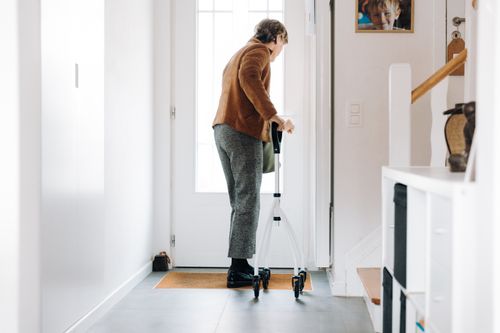
A rollator is a four-wheel walking aid with hand brakes and, usually, a seat. The differences that decide whether you love yours or leave it in the garage are not cosmetic: how much it weighs when you lift it, how big its wheels are when the sidewalk gets rough, and whether the seat height lets your feet rest flat on the ground. This guide compares well-established models on those manufacturer-published specifications. If you are still deciding whether a rollator is the right type of aid at all, read Rollator vs. Walker first — a rollator is a balance aid, not a weight-bearing aid, and the match matters.
How these picks were made: from manufacturers' published specifications — product weight, wheel size, seat dimensions, and weight capacity — not from hands-on testing, which we don't claim. Prices move too often to print responsibly; shop the specification sheet, then compare prices.
Best lightweight rollator: NOVA GetGo Classic
Most rollators weigh between 15 and 25 lb, and that weight is paid by whoever loads it into the car. NOVA's GetGo Classic comes in at about 14 lb by NOVA's catalog — genuinely light for a full-featured four-wheel model — while still carrying a 300 lb weight capacity. Specifications that matter: seat height 22.25″ with a padded seat about 13.75″ wide, handle height adjustable from 32.25″ to 36.5″, sized for users roughly 5′4″ to 6′1″, with 6″ wheels and an under-seat pouch. The 6″ wheels mark its territory: smooth indoor floors and decent sidewalks, not rough ground. NOVA also sells Junior and Petite versions with an 18.5″ seat height for shorter users — a rarer and genuinely useful option, since seat fit is where many rollators fail smaller people.
Best for outdoors: Drive Medical Nitro Euro Style Rollator
Wheel diameter is destiny outdoors. The Nitro's 10″ front casters — against a typical 6″–8″ — roll over sidewalk cracks, thresholds, and park surfaces that stop smaller wheels, and Drive Medical rates it to 300 lb capacity. It weighs about 17.5 lb: not the lightest here, but reasonable for a big-wheel aluminum frame. The design hides the brake cables inside the frame (one less thing to snag), folds with one hand by pulling the seat grip, and includes a storage bag. Handle height adjusts to suit average-to-tall users, with a tall version available. If your walking life is outdoors — mailbox runs, parks, shopping streets — this is the specification profile to beat.
Best for comfort: Medline Premium Empower Rollator
The Empower is the comfort-first entry, and its trade-off is stated plainly: at about 23 lb, it is the heaviest pick in this guide, in exchange for the best seat in the class. Medline specifies an oversized memory-foam seat (16″ × 14″) whose height adjusts from 20.5″ to 24.5″ — unusual, and valuable, because seat height is normally fixed — plus a padded backrest that flips so you can sit facing either way, and a seat that lifts so you can step inside the frame to reach a counter. Wheels are 8″, capacity is 300 lb, and it folds flat for storage. Choose it when the rollator will mostly live at home or travel by someone else's lifting, and sitting comfort is the priority.
Best heavy-duty rollator: Drive Medical Go-Lite Bariatric Rollator
Standard rollators are rated to 300 lb, and that limit is a hard safety line, not a guideline. Drive Medical's Go-Lite Bariatric model uses a steel-reinforced frame rated to 500 lb, with a wider seat and a removable padded backrest; it weighs about 26 lb, which is the honest cost of that capacity. If the user is within roughly 20 lb of a standard model's limit, shop the heavy-duty class instead — capacity headroom is safety margin.
Best on a budget: buy the specification sheet, not the brand
Entry-level aluminum rollators from the established manufacturers (Drive Medical, Medline, NOVA) share most of what matters. A sound budget rollator has: a stated capacity of 300 lb from an identifiable manufacturer; loop-style hand brakes (squeeze to slow, push down to lock) rather than push-down-only brakes if the user has the hand strength for them — loop brakes give far better control on slopes; 6″ wheels for indoor use or 8″ if sidewalks are in the plan; a padded seat and backrest; and a fold you can manage. What to give up at a budget price, in order: the storage bag, the big wheels, the plush seat. What never to give up: stated capacity, working locking brakes, and a height range that fits the user.
Brakes: the feature to understand before anything else
Rollator brakes come in two main styles. Loop-lock brakes work like bicycle brakes: squeeze the lever under the handgrip to slow down, push it down until it clicks to lock for sitting or standing. They give real control on slopes and are the better choice whenever the user has the hand strength to squeeze them. Push-down brakes engage when you press down on spring-loaded levers or the rear frame — no squeezing needed, which suits weak or arthritic hands, but they offer no way to feather your speed on a hill; they are effectively on or off, and are best kept to flat, indoor territory. A third option on some models, sometimes called a slow-down or drag brake, adds adjustable rolling resistance for users who tend to have the rollator run away from them. Match the brake to the hand and the terrain, not to the price.
A note on three-wheel rollators
Three-wheel models (tri-walkers) turn in a much smaller circle and are often the lightest option in a manufacturer's range, which makes them tempting for small homes. The trade-offs are real: most have no seat, the single front wheel finds cracks and thresholds more easily, and they offer less stability than a four-wheel model. For an active, steady user in a small apartment they can be the right tool; for anyone choosing a rollator partly for the seat or for outdoor ground, stay with four wheels.
Fit checks to run on any rollator
- Handles at wrist crease. Standing tall, arms relaxed, the grips should meet the crease of your wrist — same rule as for walkers. Confirm the model's handle range includes that height.
- Seat height: feet flat. Sitting on the seat with your back against the backrest, both feet should rest flat on the floor. Dangling feet make standing up harder and less stable.
- Brakes lock, every time. Before sitting or standing, the parking brakes must be locked. Practice the motion at home until it is automatic.
- The lift test. Whoever will load it into a car should be able to lift its stated weight comfortably — check the number before you buy, not at the curb.
- Doorway width. Compare the rollator's overall width with your narrowest doorway, with an inch to spare.
More mobility guidance — walkers, wheelchairs, scooters, and canes — is gathered in the Mobility Aids section.
Sources consulted: NOVA Medical Products catalog specifications (GetGo Classic: weight, capacity, seat and handle dimensions); Drive Medical product specifications (Nitro RTL10266 and Go-Lite Bariatric 10215: capacity, wheel size, weight); Medline product specifications (Premium Empower: seat dimensions and adjustability, weight, capacity). All figures checked against manufacturer listings in November 2026; confirm on the manufacturer's page before buying, as models are revised.
This guide is general information. A rollator must match the user's balance, strength, and brake ability — a physical therapist can assess fit in one visit.